


.svg)


How Mobile Apps Help Riyadh Businesses Scale Faster in Saudi Arabia
Customer expectations change very quickly as they browse and buy everything through their favorite mobile apps.
A good mobile app keeps your users connected and engages them more with a smooth UX. It keeps them loyal to your business across iOS and Android devices.
Companies are using apps to stay competitive. Success requires more than just basic mobile app development. It demands the right strategy, features, and dev partner.
Let’s break down how mobile apps fuel business growth in Saudi Arabia. We’ll cover benefits, real use cases, common pitfalls, and rollout best practices.
How We Conducted Our Research
We grounded this guide in direct analysis of 25+ mobile app projects delivered between 2023 and 2026.
We reviewed post-launch performance trends across retail, logistics, healthcare, fintech, education, and service sectors. We examined patterns in customer engagement, operational efficiency, and revenue expansion.
We aligned our findings with Saudi digital adoption trends and market growth indicators to ensure Riyadh-specific relevance.
Our senior product strategists and solution architects reviewed all the insights for practical accuracy.
The Riyadh Market Is Structurally Mobile-First
Saudi Arabia’s business landscape has shifted fast. People now live on their phones for everything. Ignoring mobile means losing customers and slowing growth.
Saudi’s mobile-first consumer behavior
Almost every person in Saudi Arabia now uses the internet. Numbers are near 99 % nationally.
And billions of mobile connections (over 48 million) mean phones are in everyone’s pocket.
Mobile payment adoption has also surged. Digital wallets, contactless payments, and app-based transactions are now mainstream.
Consumers increasingly prefer paying through apps rather than handling cash or visiting physical counters. On-demand behavior has become the norm.
Whether ordering food, or booking medical appointments users expect real-time access and immediate confirmation. If you fail to offer this experience, you risk losing market share.
Why Traditional Growth Channels Are Slowing
Traditional growth channels are becoming more expensive and less predictable. Paid advertising costs continue to rise as competition increases.
Marketplace platforms control visibility through algorithms that businesses cannot influence directly. Offline growth strategies scale slowly and require heavy operational effort.
Relying solely on third-party platforms exposes businesses to algorithm shifts, fee increases, and policy changes. Without direct customer ownership, long-term growth remains fragile.
The 3-Stage Mobile Scaling Framework for Saudi Businesses
Scaling through mobile apps doesn’t happen randomly. It follows a predictable progression. These three stages transform an app from a digital tool into a long-term scaling engine.
Stage 1: Direct Customer Ownership
Riyadh businesses that grow faster use mobile apps to first control customer relationships, then automate operations, and finally build data-driven growth systems.
Before Mobile Apps
Before adopting mobile apps, many Riyadh businesses depend on marketplaces and social media platforms for traffic.
They do not own customer communication channels. They rely on paid ads or organic visibility. Customer retention is inconsistent.
Re-engaging past buyers requires new advertising spend. Data about user behavior remains limited or fragmented across platforms.
After Mobile App Adoption
When businesses launch mobile apps, they gain a direct communication channel through push notifications.
They build first-party data assets: purchase history, preferences, and engagement patterns. Re-acquiring customers becomes cheaper. You can easily target promotions to existing users.
Engagement shifts from reactive to proactive. Customer control becomes growth leverage. Businesses move from renting audiences to owning relationships.
Stage 2: Operational Automation
Scaling requires operational efficiency. Mobile apps reduce internal friction and free up resources for expansion.
Order Processing Automation
In retail and restaurant businesses, manual order processing slows growth. Mobile apps automate order capture, confirmation, and routing.
Staff spend less time coordinating and more time serving customers. For Riyadh restaurants, app-based ordering reduces phone dependency and lowers error rates during peak hours.
Inventory and Supply Synchronization
Retailers can sync inventory across stores and warehouses in real time. Apps reduce stockouts and overstocking by providing live visibility. You can scale product variety without losing control.
Workforce Coordination and Scheduling
Service businesses and clinics can manage staff scheduling through centralized dashboards. Appointment confirmations, reminders, and updates reduce no-shows and improve utilization rates.
Reduction in Manual Errors
Automation minimizes data entry mistakes, duplicate bookings, and missed orders. Reduced operational friction means the business can handle higher volume without proportionally increasing headcount. Internal efficiency directly supports external expansion.
Stage 3: Data-Driven Growth Loops
Mobile apps do more than automate tasks. They generate data that fuels growth loops.
Customer Behavior Tracking
Apps track browsing patterns, purchase frequency, and engagement timing. Businesses gain insight into what customers want and when they want it.
Retention Engineering
Push notifications, in-app messages, and targeted offers re-engage users strategically. Instead of generic campaigns, businesses deploy segmented promotions.
Personalized Offers and Dynamic Pricing
Retail and e-commerce businesses use user data to personalize recommendations. Personalized offers increase conversion rates and repeat purchases.
Predictive Demand Insights
Historical usage patterns enable businesses to anticipate demand spikes. Restaurants can prepare for peak times. Logistics companies can allocate drivers efficiently.
Over time, data compounds. Each interaction strengthens predictive capability and operational accuracy.
The 7 Biggest Ways Mobile Apps Drive Business Growth in Riyadh

1) Higher customer retention and repeat sales
A mobile app acts like a storefront in every pocket, strengthening daily brand recall. Data shows around 65% of users who enable push notifications return to an app within 30 days.
Features like push alerts, saved carts, loyalty programs, and one-tap reorders reduce friction and increase repeat usage.
Compared to mobile websites, apps consistently deliver higher engagement and retention over time.
2) Faster customer acquisition through better engagement
Apps help you engage faster, not just louder. They create timely moments that pull users back in. Personalized lifecycle messaging improves onboarding and activation.
- Push notifications allow you to reach customers instantly:
- Offers and limited-time promotions
- Order updates and service reminders
- Product launches and important announcements
Users receive messages that match their behavior, not generic blasts. This relevance improves engagement and strengthens acquisition quality.
3) More conversions with smoother user journeys
Most conversions fail due to friction. Apps remove it with saved logins, addresses, and preferences.
Faster checkouts keep momentum high, reduce drop-offs versus mobile websites, and compound conversion gains as traffic scales.
4) Direct communication channel you own
Social algorithms change constantly, but app notifications reach users directly. Mobile apps give you a channel you fully control; no feed competition.
With real-time, behavior-based messages, you maintain engagement, boost loyalty, and drive sales without relying on third-party platforms.
5) Automation that lowers operational cost per order
Apps quietly reduce operational pressure as businesses scale. They replace manual steps with automated workflows.
- Common app-driven processes include:
- Orders, bookings, and confirmations
- Dispatch and delivery tracking
- Support requests and status updates
Automation reduces errors and speeds up response times. As volume increases, operational costs stay under control. That efficiency protects margins during growth phases.
6) Better decision-making with first-party analytics
When you own the app, you own the data. First-party analytics reveal user behavior, conversion funnels, and churn risks.
This insight informs pricing, offers, and product decisions. In Riyadh’s competitive market, data-driven clarity becomes a decisive growth advantage.
7) Stronger brand perception and competitiveness
Let’s be honest: apps signal maturity. Customers trust brands that invest in seamless mobile experiences.
Mobile presence suggests reliability, innovation, and customer focus. Such perception helps you win over new audiences and retain existing ones.
How Different Riyadh Industries Scale Through Mobile App

Riyadh businesses scale through proven local execution, not theory. Mobile apps win by solving real operational and customer challenges. Here’s how this works across key industries:
Retail & E-commerce
Retailers expand product catalogs and introduce loyalty programs through apps. Real-time inventory updates and personalized promotions increase retention and sales volume.
Logistics & Delivery
Delivery companies use mobile apps for route optimization and fleet tracking. Real-time updates improve efficiency and reduce delivery times, enabling larger service areas.
Healthcare
Clinics automate booking, reminders, and patient record access. Reduced no-shows and streamlined workflows allow clinics to serve more patients without expanding on-spot facilities.
Education
Educational institutions use apps to offer digital courses, assignments, and assessments. Enrollment scales beyond physical classroom limits.
Real Estate
Real estate firms capture leads instantly through app-based property listings. Immediate engagement accelerates conversion and reduces dependency on listing portals.
Revenue Acceleration Mechanisms Enabled by Mobile Apps
Mobile apps create multiple monetization levers. Revenue growth becomes systematic rather than accidental.
Increased Purchase Frequency
Push notifications and loyalty rewards encourage repeat transactions. Businesses move from occasional purchases to habitual engagement.
Higher Average Order Value (AOV)
Bundled offers, product recommendations, and limited-time promotions increase cart size. Upselling becomes integrated into the buying experience.
Subscription and Membership Models
Apps enable recurring revenue models. Premium memberships, loyalty tiers, and subscription services stabilize cash flow.
Cross-Selling and Upselling Automation
Data-driven recommendations allow businesses to suggest complementary products automatically. Cross-selling becomes scalable without manual effort.
Digital Wallet and Payment Convenience
Faster payment processes reduce friction at checkout. Saved payment methods and digital wallets improve conversion rates.
Multi-Branch and Multi-City Expansion Through App Infrastructure
Scaling physically requires centralized digital control. Digital infrastructure enables physical growth without chaos.
Centralized Operations Dashboard
Business owners monitor sales, inventory, and performance metrics across branches through one dashboard.
Performance Monitoring Across Locations
Location-based analytics reveal which branches outperform others. Decision-making becomes data-driven.
Unified Pricing & Promotion Control
Businesses adjust pricing and promotions across locations simultaneously. Campaign consistency strengthens brand identity.
Geo-Targeted Campaign Scaling
Push notifications and offers can target specific neighborhoods in Riyadh. Marketing becomes localized yet centrally controlled.
When Mobile Apps Do Not Accelerate Scale
Mobile apps are powerful growth tools; but only when the fundamentals are strong. In the wrong conditions, they amplify weaknesses instead of solving them.
Weak Product-Market Fit
If customers don’t clearly value your offering, launching an app won’t create demand. It simply digitizes a weak proposition.
Poor Backend Operations
Broken inventory systems, slow fulfillment, or staff misalignment become more visible when digitized. Technology exposes operational gaps.
No Acquisition Strategy
An app without a user acquisition plan struggles with low downloads and poor engagement.
Underfunded Infrastructure
If hosting, updates, and support are neglected, performance issues damage trust and limit growth potential.
Common Mistakes that Slow Down App-driven Growth
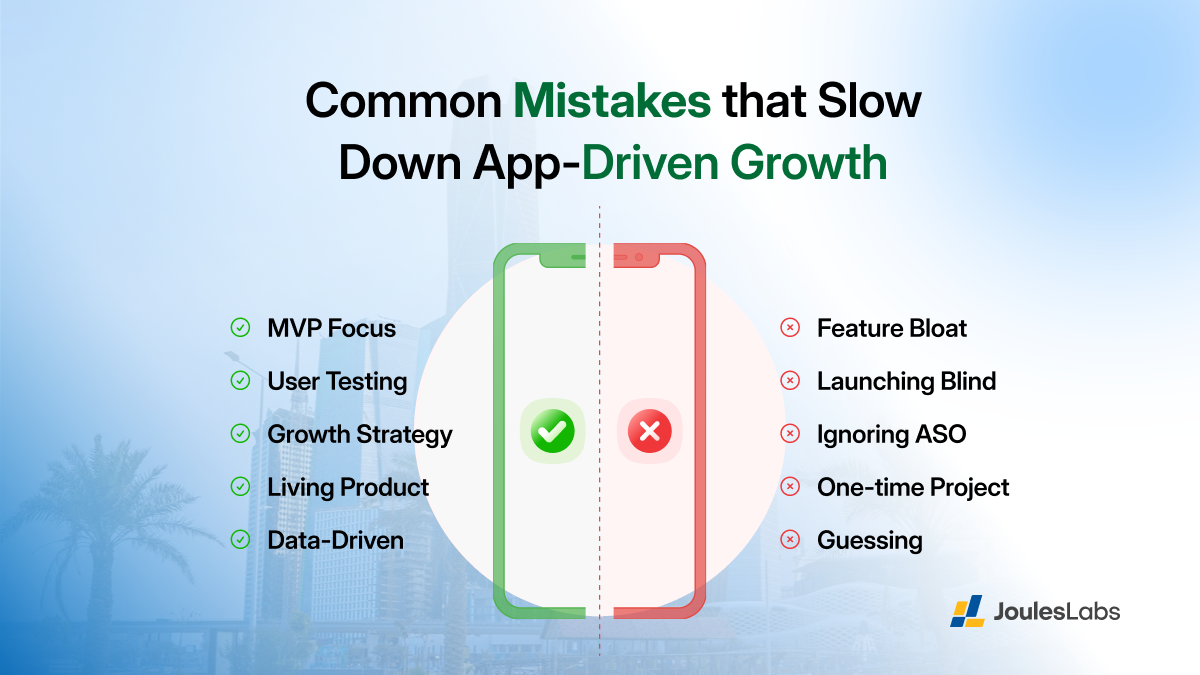
Most apps don’t fail because of bad ideas. They fail because of avoidable execution mistakes. In Riyadh’s fast-moving market, these mistakes slow growth quickly.
Here are the most common ones worth avoiding:
Feature Bloat Instead of MVP Focus
Avoid stuffing your new app with too many features. Focus on solving just one major problem for your users first. Complex designs often lead to confused customers and very late launches.
A simple first version helps you ship faster and learn sooner. Keep your initial app focused so that people can onboard easily.
Skipping User Testing and Launching Blind
Some teams build quietly, then launch everything at once. That usually leads to expensive rebuilds later. Early user testing exposes friction before it becomes technical debt.
Simple feedback loops reveal confusing flows and missing features. Testing small changes early is cheaper than fixing big mistakes later. Listening early protects your growth timeline.
Ignoring App Store Optimization and Acquisition Strategy
Your app will not grow simply because it finally exists today. You need a solid plan for discovery before you even launch.
Ignoring App Store Optimization limits visibility and downloads. Great screenshots and clear descriptions are vital for getting more downloads.
Launch momentum dies quickly if you do not have a distribution plan. Use ads and partnerships to give your growth the fuel it needs.
Treating the App as a “Project,” Not a Product
This mistake hurts long-term growth the most. Apps are living products, not one-time builds.
Without a roadmap, you’ll lose direction. No iteration cycles mean slow improvement.
User behavior changes, and apps must adapt constantly. Teams that stop improving lose relevance fast. Actual improvement comes from continuous learning and iteration.
Not focusing on Analytics data
Many teams delay analytics until later versions. That’s a costly oversight. Without early data, teams guess instead of decide.
Analytics should guide priorities from the first release. Growth accelerates when decisions follow real usage patterns.
A practical rollout plan for Riyadh businesses (MVP to Scale)
.png)
Most apps fail because teams rush straight to building. Smart Riyadh businesses start with clarity, not code. With this rollout plan, you can keep focus on growth, speed, and learning.
Step 1: Define the Growth Goal and Primary KPI
Before writing features, decide what growth actually means. Every app should serve one clear business objective first. Ask yourself what matters most right now:
- Revenue growth through repeat purchases
- Higher retention and engagement rates
- Operational efficiency and cost reduction
- Market expansion into new customer segments
Pick one primary KPI and commit to it. Everything else becomes secondary until traction appears. This focus prevents scattered decisions and wasted development time.
Step 2: Build the MVP With the Shortest Path to Value
An MVP is not a smaller version of the final product. It is the fastest route to delivering real value. Identify the minimum screens needed to solve one problem.
Remove every flow that does not support the primary goal. Simpler apps launch faster and learn earlier. Early users care more about usefulness than feature count.
Step 3: Launch With a Clear Acquisition Plan
Apps do not grow by accident. Launch day needs a distribution strategy. Start with channels you already control:
- Existing customers through email and WhatsApp
- QR codes in stores, branches, or delivery packaging
- Referral incentives that reward sharing
- Limited-time offers for early adopters
This creates initial momentum and valuable early data. Without users, even great apps stay invisible. Distribution is part of product strategy.
Step 4: Measure, Learn, and Iterate Every Month
Real growth begins once your app is finally in users' hands. You must track where people hesitate or leave your mobile app. Read all your reviews to find out what users really need.
Only add new features when you have clear proof of demand. Small changes will turn your app into a valuable asset. Steady progress comes from listening to your customers.
Choosing the Right Development Partner in Riyadh (optional but high-converting)
.png)
Your app idea is only as strong as the team building it. Choosing the right mobile app development companies directly impacts speed and success.
A good partner helps you scale. A bad one slows everything down. Here’s how to choose wisely:
What to Look For in a Riyadh App Development Partner
Pick a partner who truly understands the unique Saudi digital market. They should know local user habits rather than using generic templates.
Always check their portfolio for high quality Arabic and layout designs. Ensure they can build your app for both iOS and Android.
Good partners must provide long-term support even after the app launches. Do not hire anyone who plans to disappear after the delivery.
Red Flags to Watch Out For
Some warning signs appear early. Pay attention to them. Be cautious if there is no discovery phase.
Jumping straight into development usually leads to poor decisions. Avoid teams with no QA or testing plan. Untested apps damage trust quickly.
Question partners with no analytics or measurement approach. Without data, growth decisions become guesses.
FAQs
Does my small business really need an app?
Small businesses need apps if they rely on frequent repeat customers. They build loyalty and reduce your costs on digital ads. An app often becomes a shortcut for your business to grow.
Which app type drives the fastest growth?
The best results come from solving a real problem. Shopping apps increase sales by making it easy for people to buy. Booking apps are perfect for keeping clinics or salons very busy daily.
What is the average time for mobile app development in Saudi Arabia?
Most basic apps take about 8 to 14 weeks to build. Features like local payments and Arabic support will add more time. It is better to focus on clarity rather than rushing development.
What features do Saudi users expect?
You must include Arabic support and proper right-to-left screen layouts. Local payment options like Mada or STC Pay are very important. People love apps that feel local and are very easy.
Can a PWA replace a native app?
A PWA is cheaper and much faster to launch for beginners. However, native apps are much better for long-term customer loyalty. Choose a PWA if you mainly want to share simple content.
How do I measure my app’s ROI?
Pick one clear goal to track your app's success. Track how often people buy things or how much time is saved. Real success comes when data helps you make better business choices.
Conclusion
Apps act as growth engines that help Riyadh businesses scale much faster. They boost your sales and make your daily operations a lot smoother.
You get valuable data that helps you make much better business choices. A smart strategy removes friction throughout the entire customer journey.
If you’re considering a mobile app, the next step matters most. Start with MVP planning to define your fastest path to value. Or audit your existing app to identify growth bottlenecks.
.svg)