


.svg)


How to Choose the Best Mobile App Development Company in Saudi Arabia

If you’re building a mobile app, choosing a partner gets stressful fast. I’ve seen great app ideas fail because the wrong company was selected.
In Saudi Arabia, that mistake usually means wasted budget and missed timelines. The right mobile app development company protects scalability and future growth.
So instead of advice fluff, let’s talk about how decisions actually happen. This guide works like a scoring framework that I’d use myself.
You’ll get clear questions, warning signs, and contract tips worth knowing. We’ll also cover Saudi regulations, local market realities, and Vision 2030.
So, let’s get you a hands-on checklist to hire your next development partner!
How We Conducted Our Research
We based this guide on structured analysis of 30+ mobile app projects delivered between 2023 and 2026, along with vendor proposal comparisons across local, regional, and offshore providers.
Step 1: Proposal Review and Cost Mapping
We evaluated project proposals by breaking down scope clarity, cost allocation, timeline estimates, architecture plans, QA strategy, and post-launch support structure.
Step 2: Delivery Outcome Assessment
We examined real-world outcomes including launch delays, scope revisions, App Store rejection rates, and post-launch maintenance stability.
Step 3: Risk Pattern Identification
We identified recurring red flags such as vague pricing models, weak architecture planning, and unclear IP ownership terms.
Why “Saudi-first” Selection Criteria Matter

Are you building for actual Saudi users or generic global assumptions? Does your development partner understand how local behavior, compliance expectations, and enterprise workflows shape mobile success in Riyadh?
Do not choose a vendor without Saudi market depth, since it increases execution risk from day one.
Saudi Arabia Market Realities
Saudi users expect speed, stability, and refined user experience. Arabic-first design with precise RTL alignment is not optional; it directly affects trust and engagement.
Digital payments like Mada and local wallet integrations are baseline expectations. Competition across ecommerce, fintech, and delivery platforms remains aggressive, raising quality standards.
“Saudi-Ready” Claims Often Fall Short
Surface-level localization does not equal market fluency. Translating content is different from designing culturally aligned flows.
Vendors without real Saudi deployments often underestimate compliance nuances, payment ecosystem complexity, and enterprise governance standards.
The Hidden Cost of Wrong Choices
Execution failures rarely appear immediately. Problems surface during scale; when infrastructure breaks, store approvals stall, or retention drops.
Rebuilds, missed launch windows, and weak security posture inflate budgets silently. Selecting the wrong partner delays growth and compounds risk over time.
Step 1: Clarify Your App Requirements Before You Shortlist Agencies
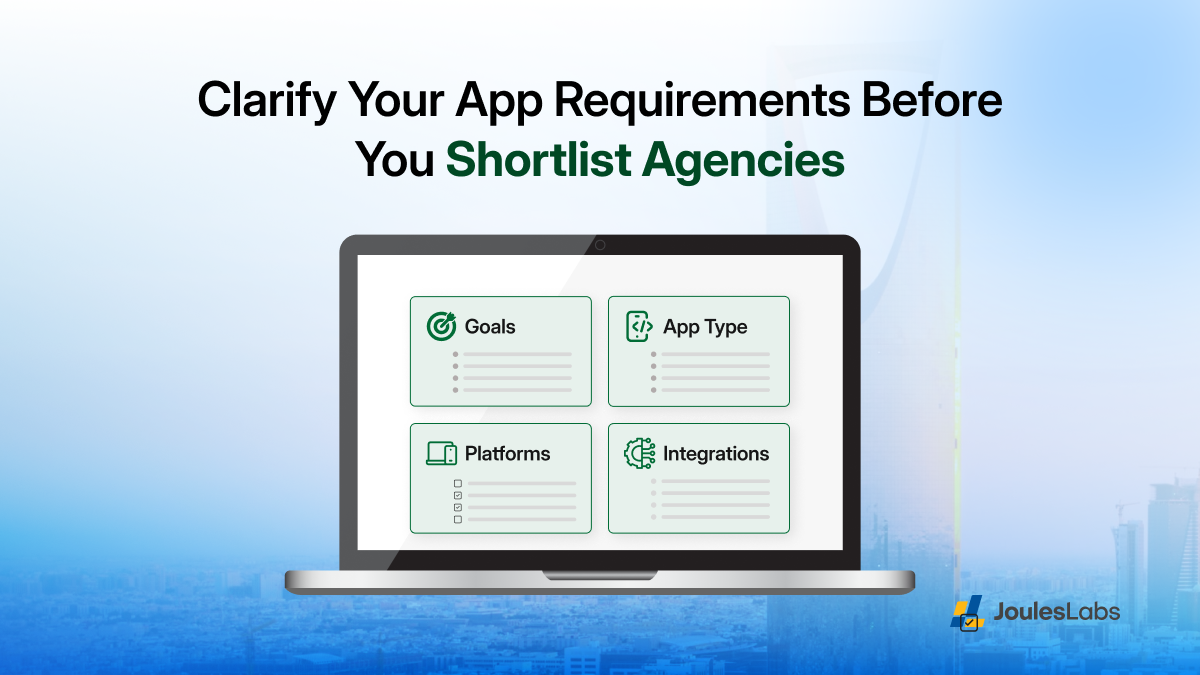
Most failed projects begin with vague expectations. Before contacting agencies, define outcomes, not just features.
Instead of saying “We need an eCommerce app,” clarify:
- Is the goal retention, operational efficiency, or geographic expansion?
- What business metric must improve?
Identify your app type and complexity early. Marketplace apps, logistics systems, fintech platforms, and internal enterprise tools have radically different architecture demands.
Decide platform strategy upfront. Native iOS, Android, or cross-platform frameworks affect cost, timeline, and scalability.
List must-have integrations early: payments, ERP systems, CRM sync, SMS gateways, analytics tools. Late integration discovery commonly increases project cost by 15-25%.
Align technical ambition with operational readiness. A scalable app cannot compensate for broken backend processes.
Step 2: Where to Find Reputable Mobile App Development Companies in Saudi Arabia
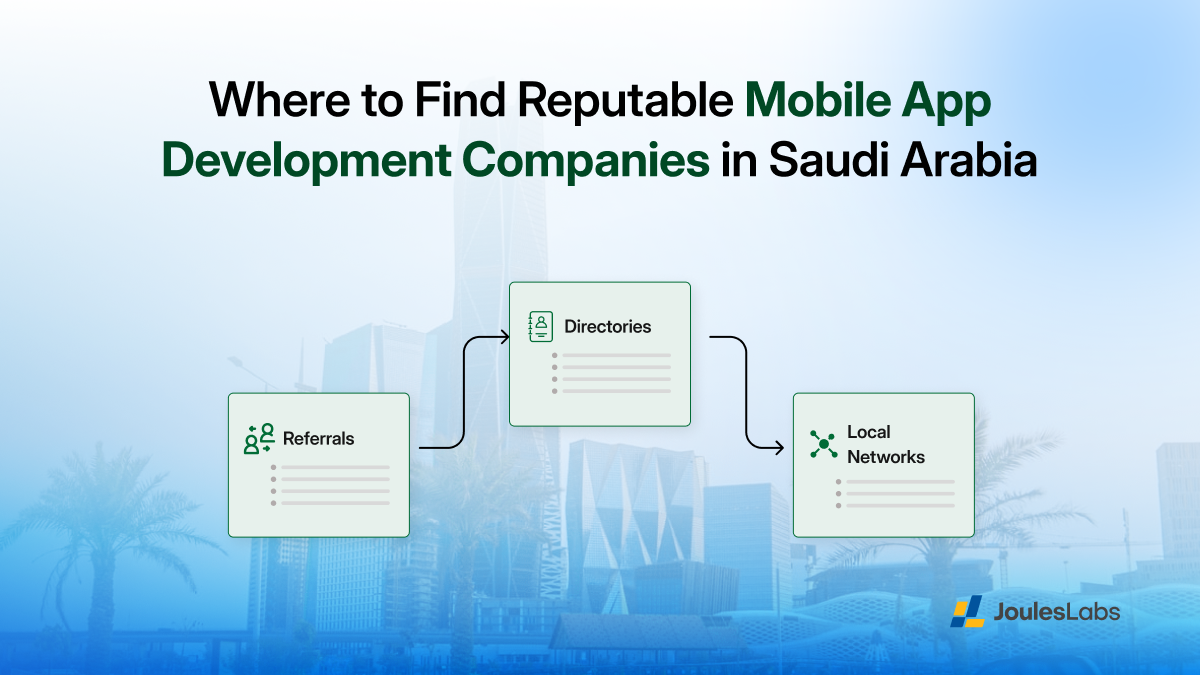
It takes more than quick Google searches to find a good mobile app development company. Focus on quality inputs before shortlisting, it will save weeks of effort later.
Sources that produce better candidates
Referrals from industry peers usually surface trusted, proven app development teams. These vendors already understand expectations, communication styles, and delivery pressure.
Verified portfolios and detailed case studies reveal real execution depth. Don’t look for just screenshots or app store links, focus on measurable outcomes.
Review platforms and Google reviews help, but use caution always. Many reviews lack context around budget, scope, or technical complexity.
Shortlist rules to avoid wasting time
Always shortlist between three and six serious vendors only. Fewer limits comparison; more creates confusion and slow decisions.
Industry complexity must match vendor experience closely. Fintech or healthcare apps demand stronger security and compliance expertise.
Step 3: Evaluate Company Credibility and Fit (core criteria)
.png)
Until real evaluation begins, shortlisting companies feels easy. This step filters polished sellers from reliable mobile app development partners. I use these criteria to judge fit, not marketing confidence.
1) Experience in your domain and complexity
Years in business rarely predict success for your specific app. Look for teams that built apps matching your industry and scale.
Ask directly about ecommerce, delivery, fintech, healthcare, or enterprise builds. Relevant experience reduces learning curves and expensive architectural mistakes later.
2) Portfolio quality and proof
A portfolio should show clarity, not only attractive visuals. Test app speed, stability, update frequency, and recent user reviews.
Strong teams track before and after metrics like retention. Conversion improvements signal product thinking with development execution.
3) Product thinking and feedback culture
Good partners ask uncomfortable questions before writing code. They challenge assumptions instead of agreeing with every requirement blindly. Constructive pushback often saves months of rework later.
4) Team resources and delivery capability
Apps require more than mobile app developers alone. You need designers, product managers, QA, backend, and DevOps.
Ask which roles stay in-house versus outsourced externally. In-house teams usually communicate faster and stay accountable longer.
5) Technical skills and platform coverage
Strong teams handle native iOS and Android development confidently. Cross-platform frameworks work well when chosen for the right reasons. Backend APIs, admin panels, and scalable infrastructure matter equally.
6) Process maturity and project management
Ask how discovery, sprints, demos, and backlog grooming work. Clear sprint cadence keeps stakeholders aligned and reduces surprises. Visibility builds trust and avoids last-minute delivery chaos.
7) QA, testing, and release readiness
Quality assurance separates stable apps from rushed launches. Ask about device coverage, regression testing, and performance benchmarks. Release readiness prevents embarrassing app store rejections later.
8) Post-launch support and maintenance
Launch is not the finish line for successful apps. Clarify SLA, response times, bug fixes, and update cycles. Reliable support protects retention and long-term business value.
9) Security, confidentiality, and protecting your idea
Your app idea deserves structured protection from day one. NDAs, access controls, secure repositories, and data policies matter. Mature teams treat security as baseline responsibility.
10) Communication rhythm and regular updates
Ask how often updates, demos, and documentation get shared. Consistent communication prevents misunderstandings and scope drift.
Step 4: Saudi-specific Checks Many Buyers Forget
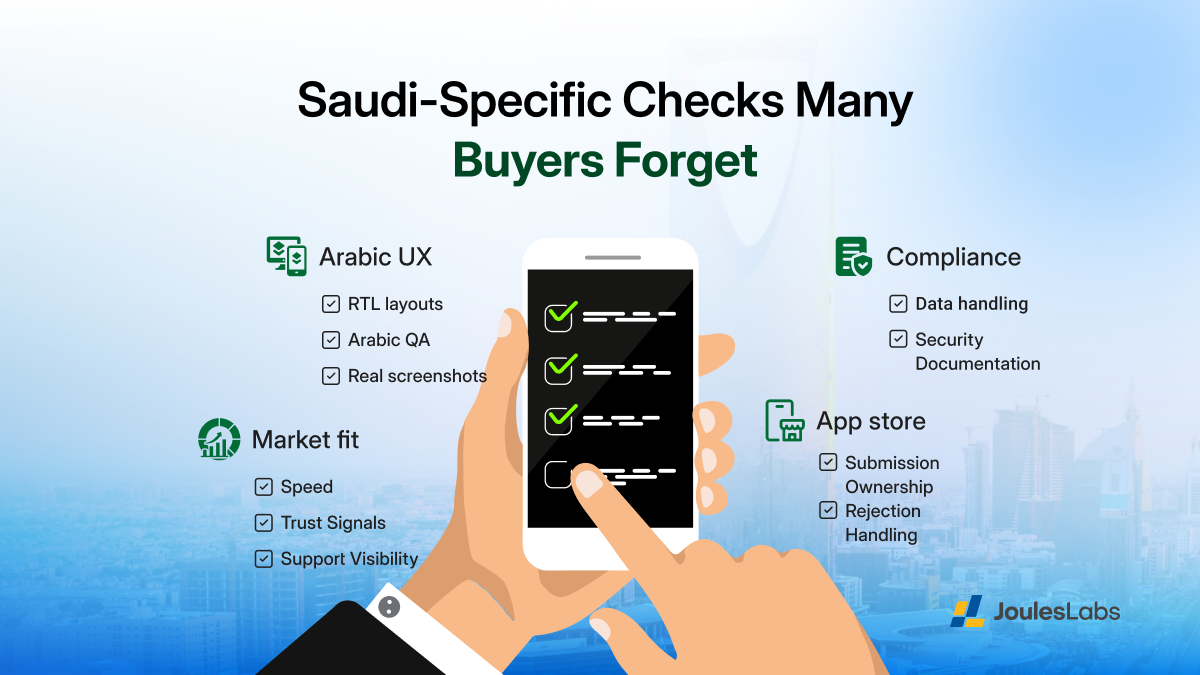
Many strong global vendors fail here due to overlooked local details. These checks separate Saudi-ready partners from risky assumptions.
Arabic and English UX with RTL support
Arabic UX requires more than translated strings inside an interface. Ask for real Arabic screenshots showing RTL navigation and layouts.
Check spacing, typography, alignment, and interaction flows carefully. Proper localization includes Arabic QA, and last-minute language fixes.
Local market understanding
Saudi users expect speed, clarity, and visible trust signals immediately. Payment transparency and customer support access influence conversion rates.
Apps lacking local context lose credibility fast in Saudi Arabia. Common Saudi user expectations include:
- Fast loading times across varied network conditions
- Clear pricing, policies, and contact information
- Visible trust badges, reviews, and secure payment flows
Compliance awareness and security posture
Saudi regulations impact data storage, access controls, and app behavior. Enterprise and public sector clients demand documented security practices. Ask how teams handle compliance with Saudi laws proactively.
Local deployment and app store submission
App store approval often delays launches more than development itself. Ask who owns Apple and Google submission responsibilities clearly.
Store assets, compliance checklists, and rejection handling need experience. These checks reduce launch risk and protect long-term app performance.
Step 5: Pricing Models, Proposals, and How to Compare Quotes
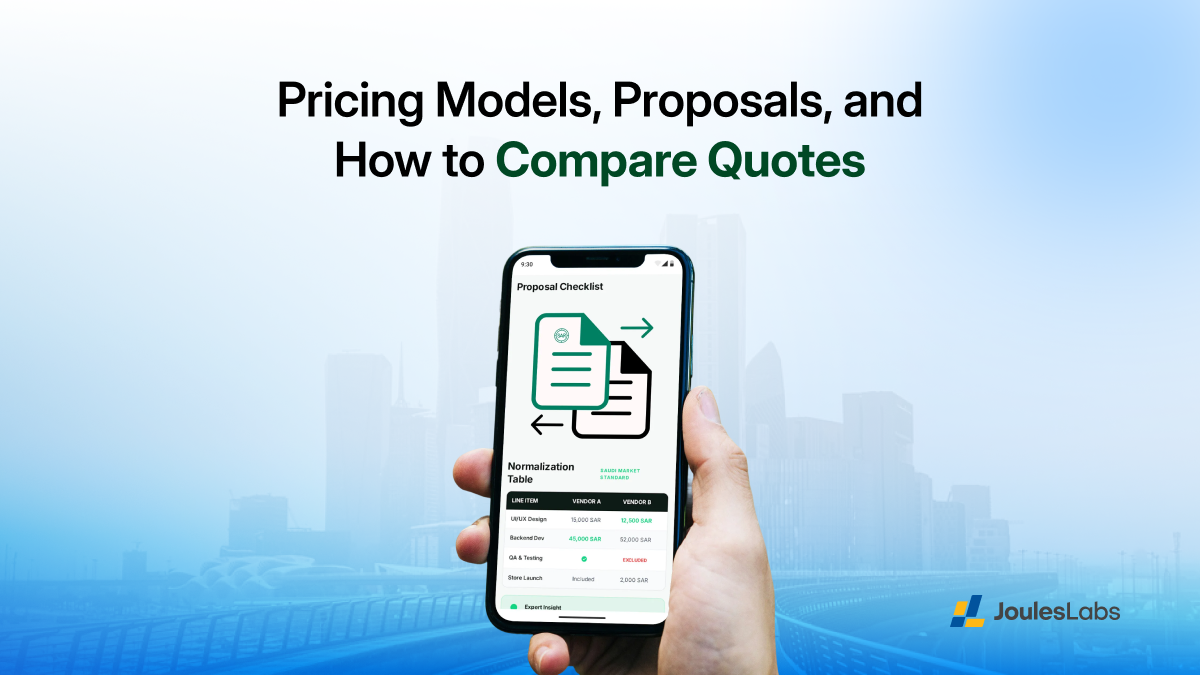
Pricing feels straightforward until proposals land and confusion begins. Numbers alone hide scope gaps, delivery risk, and future cost exposure.
Common pricing models in Riyadh projects
Most app development companies in Riyadh follow three pricing structures. Each model fits different app complexity and delivery expectations.
Fixed price model
Fixed pricing works best when scope stays stable and well-defined. Changes later usually trigger renegotiation, delays, or reduced quality.
Time and material model
This model suits evolving products, startups, and uncertain feature sets. You pay for actual effort, offering flexibility but requiring stronger oversight.
Dedicated team or monthly retainer
A dedicated team fits enterprise or long-term digital transformation goals. This model supports scalability, continuous improvements, and predictable delivery.
What a good proposal should include
Strong proposals remove ambiguity before contracts get signed. If details feel vague, risks surface later during development.
A solid proposal clearly outlines:
- Scope boundaries and assumptions tied to project requirements
- Milestones with timelines, reviews, and delivery checkpoints
- Technology stack choices for iOS, Android, or cross-platform builds
- Deliverables defined per development phase
- QA approach, testing coverage, and bug-fix cycles
- Post-launch support terms and maintenance expectations
Clear documentation signals process maturity and enterprise-grade discipline.
Apples-to-apples quote comparison checklist
Quotes often differ because line items hide inside bundled pricing. Always normalize proposals before comparing final numbers.
Ask these questions for every vendor:
- Does pricing include UI/UX design or only development?
- Are backend services and admin panels included explicitly?
- Is QA bundled or charged as a separate phase?
- Does deployment and app store submission cost extra?
Missing items usually reappear later as surprise invoices.
Step 6: Questions to Ask in Discovery Calls (copy/paste)
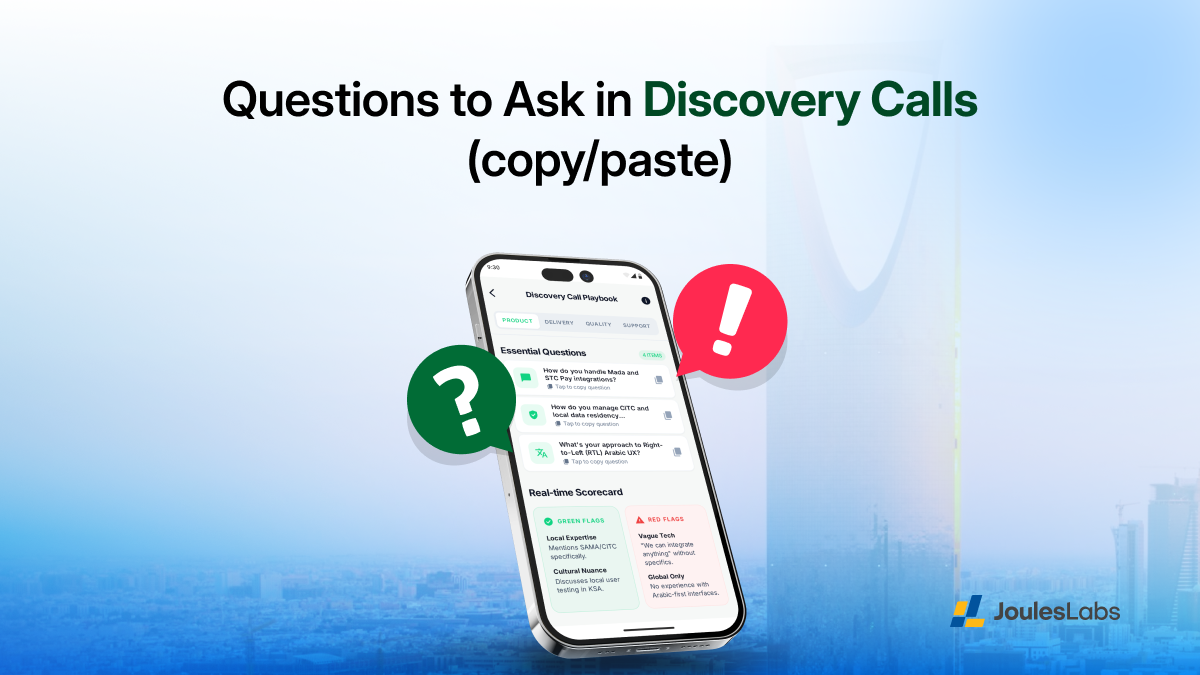
Discovery calls reveal more than polished decks ever will. Good questions expose thinking, process maturity, and delivery discipline fast. Use these questions directly and listen carefully to how answers sound.
Product and strategy questions
Ask how teams think before they write code. Strong partners talk outcomes; they don’t focus on feature checklists immediately.
Copy and paste these questions:
- “How would you reduce scope for MVP without hurting value?”
- “Which features would you delay to protect timelines and budget?”
- “What KPIs define success for this app after launch?”
- “How do business objectives influence your technical decisions here?”
Clear answers show product thinking and user-centric judgment.
Delivery and team questions
Delivery quality depends on real people; it doesn’t rely on just company logos. You deserve clarity before any contract discussion begins.
Copy and paste these questions:
- “Who exactly will work on my project, and roles?”
- “Which team members are in-house versus outsourced?”
- “How do you handle scope changes during development?”
- “What happens when timelines start slipping?”
Quality and security questions
Quality issues cost more after launch than before development. Security gaps damage trust quickly, especially within the Saudi market.
Copy and paste these questions:
- “What testing types run before launch, and when?”
- “Do you test performance, security, and edge cases?”
- “How do you protect confidentiality and intellectual property?”
Vague answers signal future risk.
Post-launch questions
Launch marks responsibility, and project completion. Support maturity predicts long-term app success.
Copy and paste these questions:
- “What happens after launch regarding bugs and updates?”
- “How do you handle OS updates and monitoring?”
- “What response times apply during critical production issues?”
Clear SLAs show an ownership mindset.
Strong answers vs. weak answers
Good discovery calls feel specific, calm, and grounded in experience. Use this simple comparison during calls.
Step 7: Red Flags When Choosing a Mobile App Development Company in Saudi Arabia

Red flags usually appear early, but buyers ignore them politely. In Saudi Arabia, those signals often lead to delays and rebuilds. Use this list to protect budget, timelines, and ownership.
Red flags in scope and process
Process problems surface before technical issues every single time.
- No discovery phase before estimates or contracts get shared
- No written deliverables, assumptions, or documented development process
- Timelines promised confidently without explaining dependencies or review cycles
These signs indicate weak planning and future scope disputes.
Red flags in quality
Quality shortcuts rarely show up in demos, only after launch.
- No QA line items mentioned inside proposals or contracts
- No clear device testing or regression testing approach explained
Lack of QA planning increases app store rejections and user churn.
Red flags in security and ownership
Security posture not only reflects maturity but also optional enterprise behavior.
- Refusal to sign NDAs before accessing sensitive information
- Unclear source code ownership or restricted repository access
These issues create legal and operational risk long-term.
Red flags in pricing
Pricing red flags feel attractive but cost more later.
- Quotes far below market without clear scope or delivery justification
- “Everything included forever” maintenance promises without defined SLAs
Sustainable partners explain limits, instead of hiding them.
Contract Essentials and Ownership Terms to Get Right
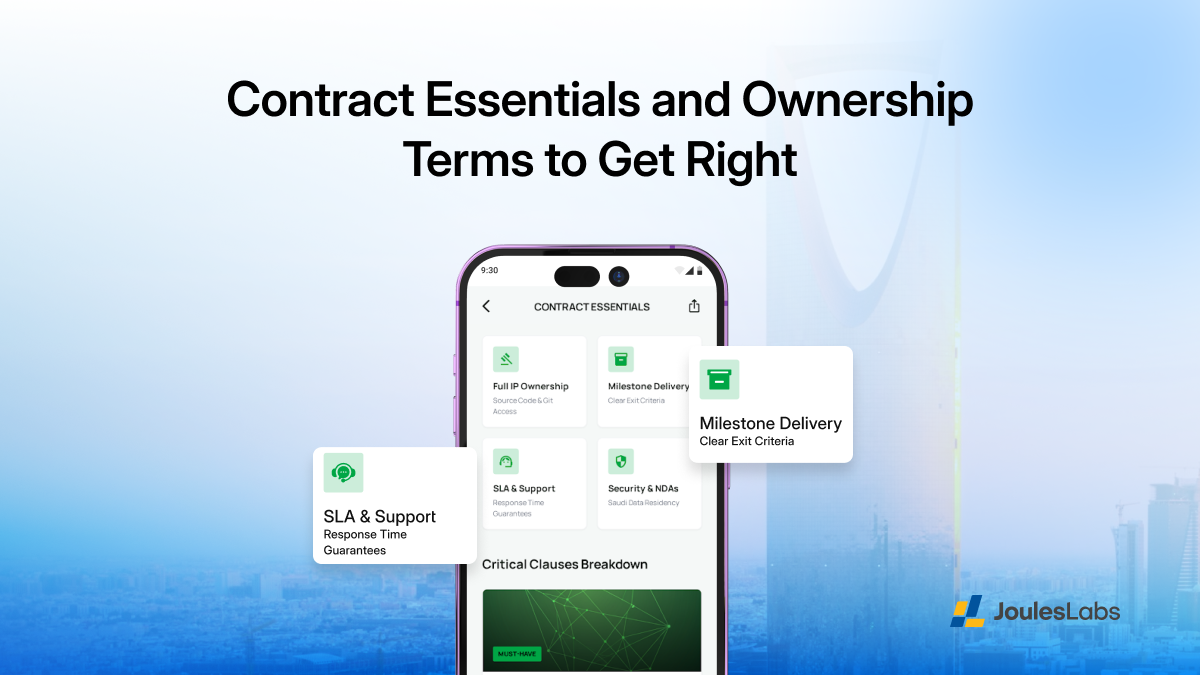
Contracts feel boring until something goes wrong. Serious buyers treat contracts as risk management.
Ownership and intellectual property
Ownership must stay clear from day one. Your contract should state full source code ownership explicitly. Access to repositories should remain unrestricted after final payment.
Third-party libraries must be listed with proper licensing terms. Unlicensed dependencies create legal risk later during audits or exits.
Milestones and acceptance criteria
Milestones prevent endless development and vague completion claims. Each milestone needs a clear definition of “done.” Done should mean QA-passed, documented, and store-ready builds.
Acceptance should follow written criteria; just mere verbal confirmation calls won’t do. Clear acceptance rules protect both sides during delivery disputes.
Support and SLA terms
Launch does not end responsibility for a professional development partner. Contracts should define a post-launch bug fix window clearly.
Response times must differ for critical, major, and minor issues. Undefined support terms usually lead to slow responses later.
Security and confidentiality clauses
Security expectations must appear in writing, instead of assumptions. NDAs should apply to ideas, data, and internal documentation.
Access management rules must cover repositories, servers, and third-party tools. Data handling responsibilities should align with Saudi regulations explicitly.
Strong contracts set expectations before emotions get involved. Clear ownership and terms create smoother partnerships and fewer conflicts.
Recommended decision framework for Saudi businesses
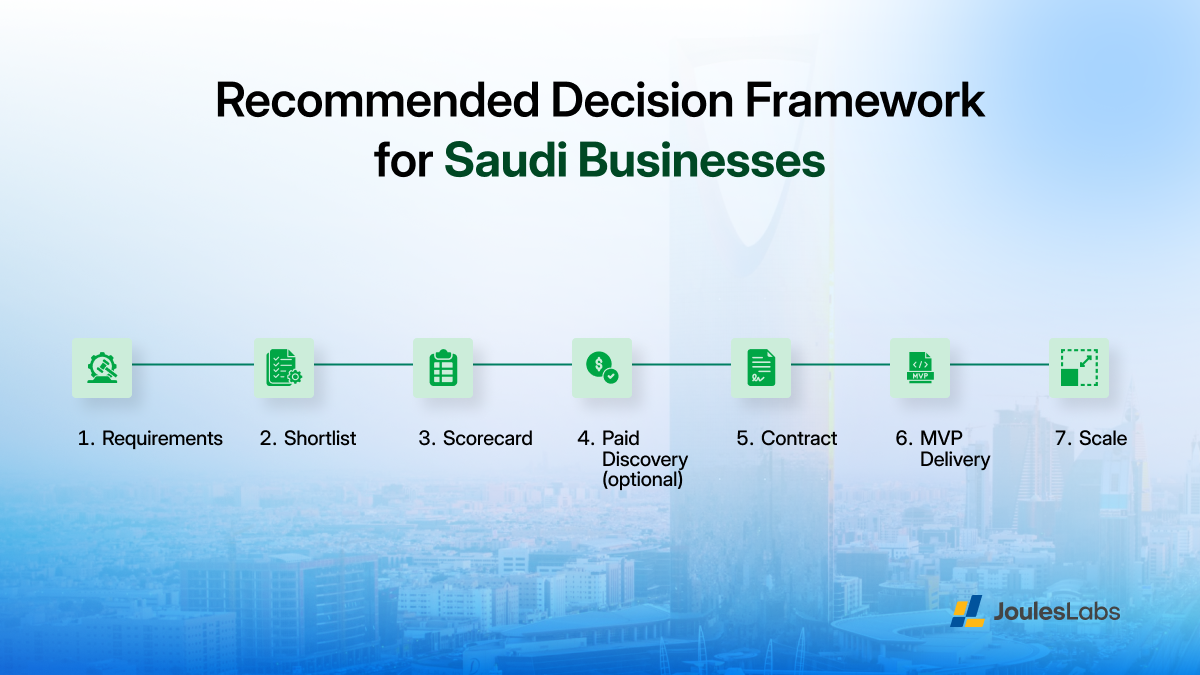
Decision frameworks remove emotion from vendor selection and reduce costly mistakes. Saudi businesses benefit from structured steps instead of rushed comparisons.
Here’s a simple, repeatable selection flow:
- Requirements: Define goals, platforms, integrations, constraints, and success metrics clearly.
- Shortlist: Select vendors based on relevance, not brand names or lowest pricing.
- Scorecard: Compare capability, process maturity, and risk using weighted criteria.
- Paid discovery (optional): Validate assumptions, scope, and technical approach before major commitments.
- Contract: Lock ownership, milestones, acceptance criteria, and support terms in writing.
- MVP delivery: Test execution speed, quality, and collaboration rhythm through real delivery.
- Scale: Expand features, users, and integrations once stability and traction appear.
Best-fit vendor by company stage
Startups should optimize for learning speed without perfect architecture. SMEs should prioritize scalability, reliability, and predictable delivery.
Enterprises must demand compliance, documentation, and structured processes. This framework keeps decisions practical while aligning partners with business reality.
FAQs
How do I choose the best mobile app development company in Saudi Arabia?
Focus on relevant experience, clear process, and local Saudi market understanding. Use a scorecard instead of relying on sales pitches or pricing alone.
How involved do I need to be during the development process?
You should stay involved through reviews, demos, and decision checkpoints. Low involvement usually leads to misalignment and rework.
How long does it take to develop a mobile app?
An MVP usually takes 3 to 4 months. Mid-level or enterprise apps can take 6 to 9 months or longer.
Should I hire a Saudi-based company or an offshore team?
Saudi-based teams understand regulations, users, and app store expectations better. Offshore teams work only if Saudi compliance and localization are covered properly.
What documents should I prepare before contacting agencies?
Prepare a short brief covering goals, target users, platforms, and key features. Wireframes help but are not mandatory early.
What should be included in app maintenance and support?
Bug fixes, OS updates, performance monitoring, and security patches. Clear SLAs and response times matter.
How do I verify an agency’s portfolio is real?
Check app store links, update history, and real user reviews. Ask what role they played in each project.
Do I need Arabic and RTL support from day one?
Yes, for most Saudi-focused apps. Arabic-first UX affects trust and adoption.
Which pricing model is best for early-stage projects?
Time and material works best for MVPs. It allows flexibility while requirements evolve.
Who owns the source code after project completion?
You should own 100% of the source code. This must be clearly written in the contract.
Conclusion
Now you know that choosing a mobile app development partner is not just a procurement task. It’s a long-term product decision that affects growth, trust, and scalability.
Your dev partner should think beyond features and deadlines. They combine product thinking with structured delivery and strong QA practices.
Security and compliance protect your app long after launch. Post-launch support ensures your product evolves with users and platforms.
In Saudi Arabia, local context makes these factors even more critical. When all these pieces align, execution feels calm and predictable. That’s usually the sign you chose the right partner.
.svg)